
Commercial Solar & Storage Engineering, Structured for Canadian Requirements
From load analysis to Professional-Engineer-stamped, permit-ready drawings, every design is built around Canada’s Clean Technology Investment Tax Credit, Class 43.1 capital cost rules, and the wind-load, snow-load, and utility interconnection standards specific to Canadian jurisdictions.
Every engineering deliverable is designed around Canada’s Clean Technology Investment Tax Credit — a 30% refundable federal credit on eligible solar and storage equipment — and Class 43.1 immediate expensing under Bill C-15’s Productivity Super-Deduction. Equipment specification, documentation, and system sizing are structured from the first drawing to support both. Full mechanics: the 30% Clean Technology ITC and Class 43.1 / 43.2 depreciation.
A C&I-First Engineering Team, Not a Residential Shop That Takes Commercial Calls
Commercial and industrial energy projects carry a different order of complexity than residential installs: structural load analysis for Canadian wind and snow conditions, utility interconnection applications, Professional Engineer (P.Eng.) approvals through the relevant provincial association, and documentation built to survive a CRA audit of the ITC claim. My Energy Canada’s design and engineering process is built for that complexity — for developers, facility owners, and operators who need a partner that understands the full energy economics of a project, not just a plan set, structured from day one around Canadian tax and utility rules rather than adapted after the fact.
Engineering Services
Full-scope C&I energy engineering, from single-building commercial to multi-site industrial portfolios.
Commercial & Industrial Solar PV
C&I-scale solar design including site assessment, structural load analysis for Canadian wind and snow conditions, system sizing, Tier-1 equipment specification, and permit-ready engineering plan sets for commercial rooftops, carports, and ground-mount installations.
Battery Energy Storage (BESS)
Industrial-grade battery storage design: load analysis, charge/discharge optimization, Global Adjustment and demand-charge mitigation strategy, and complete engineering documentation for utility interconnection and permit approval. See storage configurations up to 200 kWh.
Microgrid & Resilience Design
Microgrid architecture for facilities requiring grid independence or backup power — manufacturing, cold storage, and critical infrastructure. Islanding design, energy management system specification, and full integration engineering.
How We Deliver
A structured process from first conversation to permit-ready plan set.
01. Stakeholder Coordination & Discovery
We align with your team, your architect, MEP engineers, and construction managers before drawing begins, and confirm the requirements of your local Authority Having Jurisdiction (AHJ) and utility.
02. Energy Analysis & ITC-Optimized Sizing
Load analysis and system sizing optimized for your facility’s actual consumption profile, with equipment selection structured for Clean Technology ITC and Class 43.1 eligibility from the outset.
03. Engineering Plans & Specifications
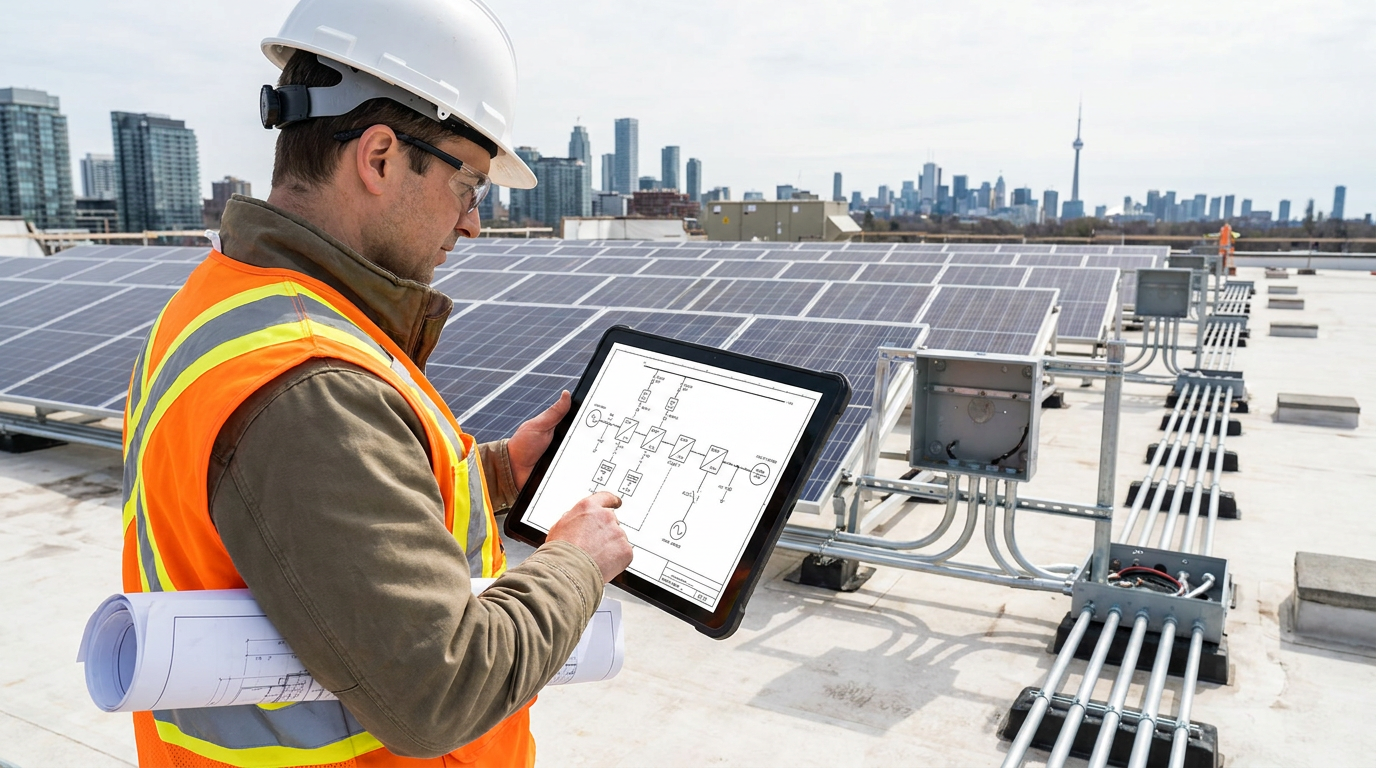
Complete electrical and structural engineering drawings — calculations, equipment schedules, wiring diagrams, and single-line diagrams — produced to the standard required by Canadian authorities.
04. Professional Engineer (P.Eng.) Approvals
Plan sets carry the stamp of a Professional Engineer licensed with the relevant provincial or territorial association — PEO, APEGA, EGBC, and equivalents — in electrical and structural disciplines, as required for your jurisdiction.
05. Equipment Specification & Supply Coordination
We specify and coordinate placement of all solar PV, storage, and balance-of-system equipment, drawing on Tier-1 hardware distribution.
06. Permit-Ready Deliverables
Final engineering drawing sets in PDF and CAD formats, submitted to your AHJ, with support through the plan review process to permit issuance.
Pre-Engineering Support
The decisions made before engineering begins determine whether a project pencils out.
Post-Engineering Support
The engagement does not end at plan delivery.
Financial & ITC Feasibility
We model the full financial picture — Clean Technology ITC eligibility, Class 43.1 treatment, projected utility savings, and payback period — so the investment decision can be made with confidence. See the ITC page and the zero-down lease alternative for financing that requires no capital outlay.
Conceptual Design, Bid Evaluation & Cost Estimation
Preliminary system layout for stakeholder and board presentations, independent technical evaluation of contractor bids and equipment proposals, and pre-engineering cost estimates for budgeting and financing purposes.
Utility Interconnection Management
We manage the technical application process for grid interconnection with your local utility, handling required documentation and engineering responses through to approval.
ITC & Incentive Documentation
Engineering documentation, prevailing-wage and apprenticeship-hour records where the full 30% rate is elected, and equipment substantiation prepared to support your CRA claim.
Start With an Engineering Consultation
Bring your facility’s utility bills and site details. We’ll scope the engineering path and the incentive stack that applies to your project.
Professional Engineer stamping is performed by engineers licensed with the applicable provincial or territorial association for the jurisdiction of the project. Incentive eligibility depends on equipment type, in-service date, and corporate structure; confirm current eligibility with your advisors and the CRA.