
Your Utility Bill Has Two Enemies: Peaks and Outages. Storage Kills Both.
My Energy Canada engineers EP Cube battery storage systems — scalable to 200 kWh — that discharge against your facility’s coincident peaks, mitigate Ontario Global Adjustment charges, flatten Alberta demand billing, and carry critical loads through grid outages. Every kilowatt-hour of it qualifies for the 30% Clean Technology ITC.
For Ontario Class A customers, Global Adjustment can exceed 60% of the total electricity bill — and it is allocated by your demand during a handful of provincial peak hours per year. A battery that discharges during those hours re-prices your entire year.
What is commercial energy storage and how does it reduce costs?
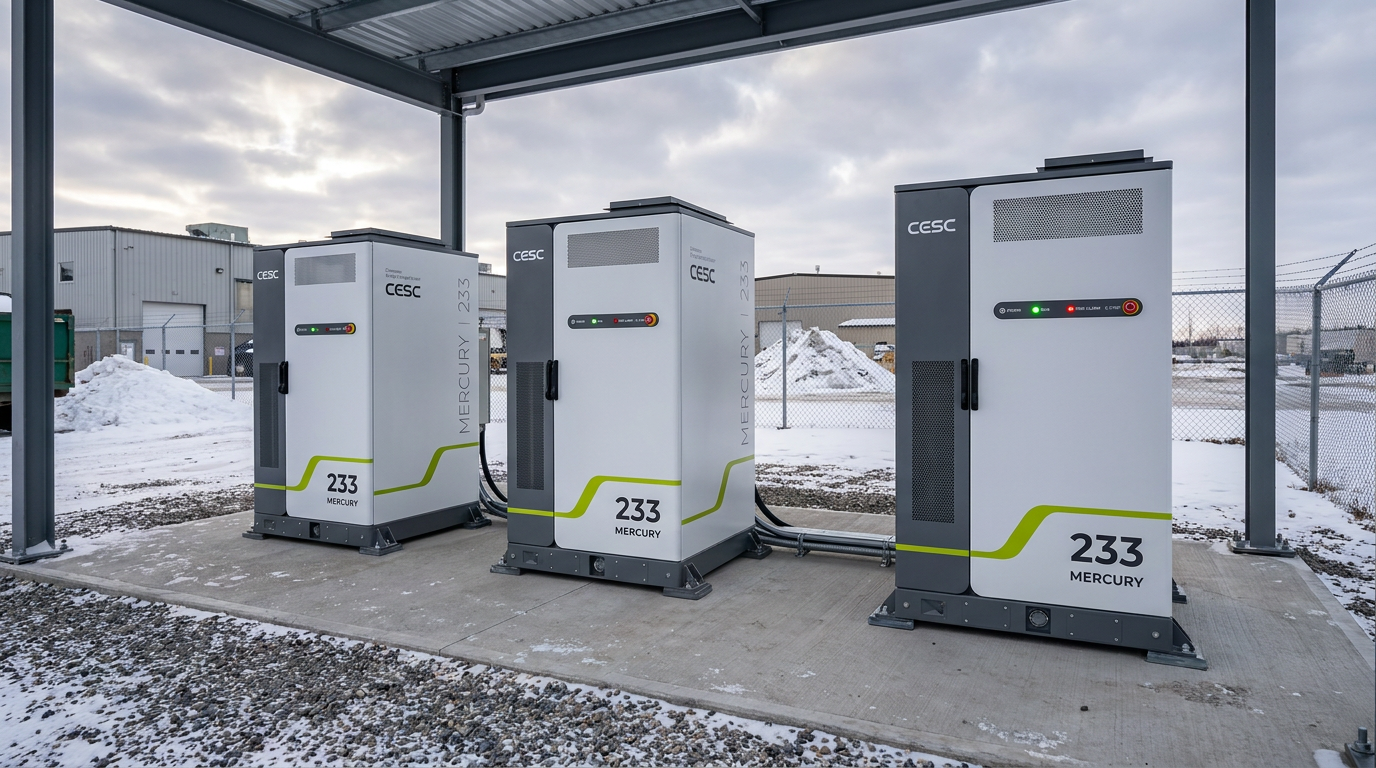
Commercial energy storage is a stationary battery system — in our deployments, the lithium iron phosphate EP Cube platform, configured from tens of kilowatt-hours to 200 kWh — installed behind your meter and dispatched by an intelligent controller. It reduces cost through three mechanisms: discharging during expensive or demand-setting intervals (peak shaving), shifting consumption to low-cost periods (arbitrage), and eliminating outage losses (backup). It is not generation; it is control over when you draw from the grid — which, under Canadian commercial rate structures, is often worth more than the energy itself.
How does peak-shaving work for Ontario Global Adjustment?
Ontario’s Global Adjustment (GA) is the mechanism recovering the province’s generation contract costs, and for large consumers it dwarfs the energy commodity charge. Facilities in the Industrial Conservation Initiative (Class A) are billed GA in proportion to their share of provincial demand during the top five system peak hours of the year. Predict those hours, discharge the battery through them, and your facility’s peak demand factor — and next year’s GA allocation — drops accordingly. Our dispatch controller runs continuous provincial-peak prediction and automates the discharge decision, so GA mitigation does not depend on a facility manager watching the IESO forecast at 4 p.m. in a July heat wave.
How does battery storage eliminate Alberta demand charges?
Alberta commercial and industrial tariffs bill a substantial portion of delivery cost on peak demand (kW) — often set by a single 15-minute interval in the month. A short, sharp load spike (compressor start, batch process, EV fleet charging window) can set your billed demand for the entire period. Storage clips those intervals: the controller detects the approaching threshold and discharges to cap the meter reading. The result is a structurally lower billed demand, month after month, from an asset that also provides backup — and that qualified for a 30% federal capital refund on the way in.
What storage configurations are available (up to 200 kWh)?
The EP Cube platform is modular: capacity scales in increments to 200 kWh per installation cluster, with power electronics sized to your load profile rather than a one-size cabinet. All installations are engineered and inspected to the Canadian Electrical Code (CEC), with thermal management specified for Canadian ambient extremes.
Light-Commercial Peak Clipping
Retail, office, and small-format industrial. Clips demand-setting intervals and provides critical-load backup at the lowest capital entry point.
GA Mitigation & Backup
Ontario Class A and large Class B facilities. Sized to carry the facility through predicted provincial peak hours while covering outage-critical loads.
Industrial Solar + Storage Microgrid
Full configuration paired with N-Type TOPCon bifacial arrays under a unified microgrid controller. Peak shaving, arbitrage, and islanding in one asset base.
Does battery storage qualify for the 30% ITC?
Yes. Stationary electricity storage that does not use fossil fuels in operation is eligible clean technology property under the Clean Technology ITC enacted by Bill C-59 — standalone or paired with solar. Storage capital cost also enters Class 43.1 for 100% first-year expensing under Bill C-15. The full sequencing is on our 30% Clean Technology ITC page and accelerated depreciation page.
What happens during a grid outage?
The system islands. On loss of grid supply, the inverter disconnects from the utility and carries your designated critical loads — refrigeration, servers, access control, process loads you define during engineering — from battery, and from solar if co-installed. Transition is automatic. When the grid returns, the system resynchronizes and resumes normal dispatch. For facilities where an outage means spoiled inventory or halted production, the backup function alone frequently justifies the asset before a single peak is shaved.
How do microgrids integrate solar and storage?
A commercial microgrid is the coordination layer above the hardware: a controller that continuously optimizes across solar production, battery state-of-charge, facility load, tariff structure, and grid conditions. Our deployments combine N-Type TOPCon bifacial solar arrays on high-wind structural steel frames with EP Cube storage under AI-driven load profiling — the controller learns your facility’s demand signature and executes peak shaving, GA response, and backup transitions as automated workflows. One asset base, four value levers: energy offset, demand reduction, GA mitigation, and resilience.
Prefer to deploy without capital outlay? Our zero-down operating lease structures the payment below verified savings.
Schedule an Engineering Load-Profile Audit
We analyze twelve months of your interval data, identify your demand-setting events and GA exposure, and size the storage configuration to the economics — before you commit to anything.